
Q1 2026 - Market Insights
Every quarter, we’ll highlight and explain a few of the key events that happened leading up to the quarter, as well as some takeaways and insight into the impact these events may have going forward. If there are any topics that you’d like us to touch on in the future, please reach out and let us know.
Q1 2026 Market Review
The Great Rotation
Over the past two years, you may have grown tired of hearing about the Magnificent 7 and how owning this group of stocks was what felt like the only way to achieve significant performance. But so far in 2026, we’ve seen signals of a return to the proven theme of diversification.
As shown below, there was a clear divergence between US Large Growth and US Large Value in the first quarter of the year. Investors appeared to shift away from high-multiple growth stocks toward more stable alternatives. US Small Cap stocks had the best return for the first quarter of 2026 at 3.51%. US Small stocks have experienced a tough five years, but in terms of valuation, they look like a good buy compared to US Large stocks. We are hopeful that this trend continues and rewards traditional investing in undervalued assets.

Source: Morningstar
Oil
The biggest headline for the quarter is the price of oil. On February 28, 2026, joint military airstrikes by Israel and the U.S. targeted Iran. The market is now trying to predict how long this conflict will last. Investors are especially focused on the Strait of Hormuz, a crucial energy chokepoint for about 20% to 25% of the world's petroleum. Disruptions to the Strait have caused sharp spikes in energy prices and physical shortages for net importers, which contribute to global inflation. As a result, oil is up 83% this year, and we are all feeling it at the gas pump.
The underlying issue is that inflation has remained elevated for the past year despite the Fed's efforts to bring it down to their 2% target. The Fed had started cutting interest rates in the second half of 2025, with the expectation that inflation was under control. The market initially predicted we would see multiple rate cuts by the Fed in 2026, but this oil shock now has the Fed saying rate hikes are possible in 2026.
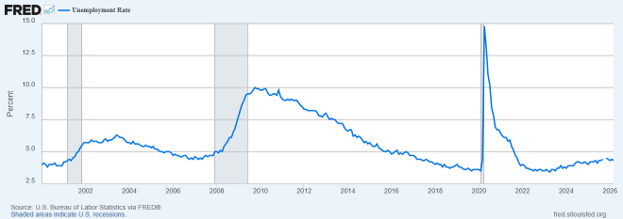
What makes the Fed’s future decisions even more challenging is that while inflation is trending upward, there appears to be weakness in the labor market. As shown below, unemployment has been creeping up over the last two years, another key area that the Fed is mandated to try and control. If the labor market weakens, the Fed typically responds with rate cuts to help prop up the labor market. With competing priorities, the Fed is in a tricky position trying to balance increased inflation and a cooling labor market.
Gold
Gold is one of the most fascinating stories to me. While our focus has been on the shifting tides of the stock market in early 2026, it’s also important to look back at gold’s historic performance in 2025. Last year, gold surged over 66% and set records by closing above $4,500 per ounce. There are three possible factors behind gold’s movement.
First, just as you buy homeowner’s insurance not because you want a fire, but because you want to be protected if one occurs, investors use gold as portfolio insurance. In 2025, as global conflicts and trade tensions continued, the world sought an asset that isn't tied to any single government’s stability, leading to the purchase of more gold.
Second, historically, the U.S. Dollar has been the world's primary reserve currency. However, in 2025, we saw a historic shift where global central banks started buying gold at a faster pace than U.S. government debt. This indicates that the world is looking for a more diverse way to store its collective wealth.
Lastly, gold usually struggles when interest rates are high because gold doesn't pay a yield (like a bond or a savings account). However, as the Federal Reserve began cutting rates in 2025, the opportunity cost of holding gold decreased. Combined with the dollar weakening by 9% last year and falling interest rates, gold became an alternative destination for capital seeking growth.
Now let’s get back to 2026. Since the war in Iran started on February 28th, gold has decreased by 14%. As mentioned above, gold can serve as an opportunity for investors. Theoretically, it is supposed to perform well during periods of high unexpected inflation and economic uncertainty. When the war began, inflation expectations suddenly rose, and we saw an increase in economic uncertainty. This would be a time when we would expect gold to thrive. Instead, it fell 14%.
My theory on why this might have happened is that when stocks declined in March, investors needing liquidity saw gold as a good asset to sell due to its recent substantial rise. Also, if the Fed decides to hold rates longer, that reduces the opportunity cost of holding gold and makes cash more attractive again.
Summary
As we look at the remainder of 2026, it is clear that we are in a period of complexity. With geopolitical tensions impacting energy prices and the Fed walking a tightrope between inflation and employment, market uncertainty feels particularly high. It is natural to feel a sense of unease.
However, there is a silver lining: the return of balance. For years, the market has been dominated by just a handful of giant tech companies, creating a top-heavy environment despite the availability of many cheaper asset classes, making many investors nervous. Today, we are seeing the market broaden. The resilience of US Small Cap stocks and the stability of Value stocks suggests that diversification is making a comeback. While the road ahead may be volatile, this shift actually lowers long-term risk by broadening your potential success; good investment opportunities are no longer tied to just one sector or a few specific names.
The goal isn't to predict every geopolitical turn or Fed decision, but to build a weatherproof portfolio that can withstand them. By staying disciplined, focusing on undervalued assets, and maintaining diversification, our goal is block out the noise of the news and stay focused on the fundamentals.
If there are any topics you would like us to address in future commentaries, please let us know.
Disclosures:
Investment advisory services offered through Elevate Wealth Management, LLC, a registered investment advisor. The firm’s ADV 2A Brochure and Form CRS are available, at no charge, by request at information@elevateasset.com or 307.461.5550 and are available on our website www.elevateasset.com. They include important disclosures and should be read carefully.
Information provided herein reflects Elevate’s views as of the date of this newsletter and can change at any time without notice. Elevate obtained some of the information provided herein from third party sources believed to be reliable, but it is not guaranteed and Elevate does not warrant or guarantee the accuracy or completeness of such information. The use of such sources does not constitute an endorsement. Elevate’s use of external sources should in no way be considered a validation. The views and opinions of these authors are theirs alone. Reader accesses the links or websites at their own risk. Elevate is not responsible for any adverse outcomes from references provided and cannot guarantee their safety. Elevate does not have a position on the contents of these articles. Elevate does not have an affiliation with any author, company or security noted within.
Past performance is no guarantee of future returns. Performance discussed represents total returns that include income, realized and unrealized gains and losses. Nothing presented herein is or is intended to constitute investment advice or recommendations to buy or sell any types of securities and no investment decision should be made based solely on information provided herein. There is a risk of loss from an investment in securities, including the risk of loss of principal. Different types of investments involve varying degrees of risk, and there can be no assurance that any specific investment will be profitable or suitable for an investor’s financial situation or risk tolerance. Diversification and asset allocation do not ensure a profit or protect against a loss. All performance results should be considered in light of the market and economic conditions that prevailed at the time those results were generated. Before investing, consider investment objectives, risks, fees and expenses.
Exclusive reliance on the information herein is not advised. This information is not intended as a recommendation to invest in any particular asset class or strategy or as a promise of future performance. References to future returns are not promises or even estimates of actual returns a client portfolio may achieve. Assumptions, opinions and estimates are provided for illustrative purposes only. They should not be relied upon as recommendations to buy or sell any securities, commodities, treasuries or financial instruments of any kind. This material has been prepared for information purposes only and is not intended to provide, and should not be relied on for, accounting, legal, investment or tax advice.
In reviewing the performance information presented here, we recommend that you consider both the returns generated and the level of risk that was assumed in generating those results. We believe that performance information cannot be properly assessed without understanding the amount of risk that was taken in delivering that performance. The performance information presented here covers different time periods. We present performance information for short time periods because we understand that clients and potential Investors are interested in this information, however, we recommend against making any investment decisions based on short-term performance information. For any investment products mentioned herein, a complete description of their investment objectives, along with details of the risks and fees involved is contained in their respective prospectus and statement of additional information, which is available on their websites and should be read fully.